
The pet apparel market has traditionally focused on functional benefits, such as providing warmth or protection. However, as pet owners move beyond mere utility and increasingly seek to deepen the emotional bond they share with their pets, "matching outfits for owners and pets" has emerged as a growing trend. What may have begun as a clever gimmick has evolved into a mature product category—complete with its own specialized terminology (such as "owner-pet matching sets"), distinct peak search seasons, and a unique economic model for production. This trend is primarily driven by two factors: the desire among pet owners—often showcased on platforms like Instagram—to express their emotional connection by wearing coordinated outfits with their pets, and the evolution of custom pet apparel into matching sets designed for both the owner and their animal companion.
Let’s take a deep dive into the current state of this niche market, the challenges it presents, and how Furvibe leverages AI to help pet apparel merchants address these issues.
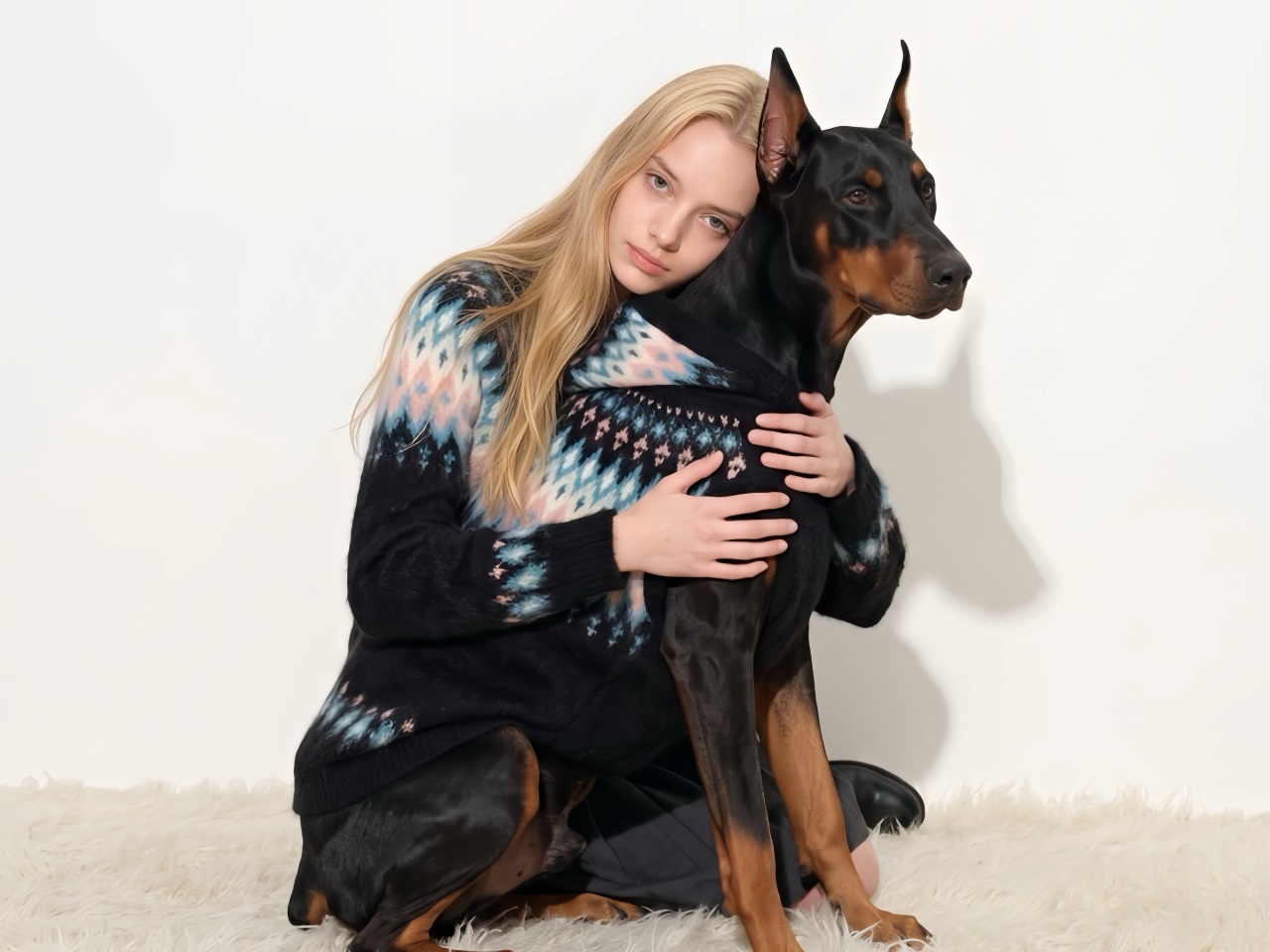
1. Instagram shows the trend before search volume confirms it
Instagram did not invent the matching set, but it industrialised it. The platform rewards images that can be understood without a caption, and a repeating pattern across two bodies does exactly that: one frame, two subjects, one story. The 2026 version, though, is noticeably quieter than the 2020 version — the full twinning costume has given way to coordinated colour.
Start with scale. Hashtag analytics put #matchingset at roughly 453 million posts, with about 29,300 new posts a day and an average of 551 likes per post — one of the most competitive tags on the platform [1]. The narrower #matchingoutfits carries about 1.7 million posts [1]. These are cross-category totals, not pet-specific, which is precisely the point: matching is a mainstream fashion behaviour that pet owners have plugged their dogs into, not a pet-industry quirk.
Search demand tells the same story with a seasonal signature. "Matching dog and owner outfits" runs at roughly 2,900 monthly searches in the US, spiking toward 6,600 in November and December [2]. That Q4 concentration is a familiar shape in this category — market research puts around 70% of annual dog-apparel revenue in the fourth quarter [3] — but the matching segment is unusual in that its demand is visual first. People search for it after they have seen it.
What changed in 2026 is the register. Style guidance aimed at this segment now recommends that owners "coordinate colours rather than patterns," keeping to two or three tones and letting the dog's harness or knit pick up one colour from the human outfit [2][4]. The current palette vocabulary is oatmeal, cream, navy, forest green — not rhinestones and reindeer. The commercial consequence is significant: a coordinated set is harder to fake than a twinned costume, because the two garments have to look like they came from the same bolt of cloth.
The brand evidence has caught up. Little Beast, a pet-wear label that has built its identity on owner-and-pet pairing, released a winter capsule with Sandy Liang in November that pairs human and pet versions of the same pieces: a puffer at $965 for humans and $149 for pets, a fleece jacket at $695 and $88, a wool cardigan at $295 and $98 [5]. Earlier collaborations with Lisa Says Gah followed the same template. Read the price ratios — roughly 4× to 11× between the human and pet halves — and you have the commercial logic of the entire trend: the pet garment is the cheap half of an expensive purchase decision, and it exists to make the human half photographable.
Table 1: Three levels of matching — and what each demands from a brand's image library
| Level | What the customer actually wears | Image assets a brand must supply |
|---|---|---|
| Subtle | One shared colour; dog in a bandana or collar in a matching tone | Detail shots that prove the colour match |
| Coordinated | Same palette and texture family; different garments | Paired flat lay + one lifestyle frame showing both |
| Full set | Same knit, print or construction, both bodies | Fit shots across breeds, plus scale reference |
2. Customisation has become the expectation, not the upsell
The matching set has turned pet owners into personalisation buyers. A generic "dog mom" hoodie is a joke; a hoodie with this dog's name on it, next to a pet version in the same yarn, is an identity purchase. The data has been moving this way for two years, and the matching category is where it concentrates.
Etsy's own trend reporting is the cleanest signal available, because it measures intent rather than opinion: custom dog-portrait searches were up 7% year over year, custom cat portraits 17%, and dog-themed gifts 30%, as of mid-2026 [6]. Independent analyses of the personalised-apparel category put the price premium for customisation at 30–50% over non-personalised equivalents, with more than 60% of pet owners saying they choose personalised accessories over generic ones [7]. One market survey puts the share of consumers who prefer premium customised pet clothing at around 48% [8] — treat that figure as directional, since survey definitions of "custom" vary widely, but the direction is consistent across sources.
Why does customisation attach so naturally to matching sets? Because a set is a coordination problem. Two garments, two body shapes, no shared sizing system — an embroidered name, a monogram, a matched print or a shared trim colour is the cheapest way to make two objects read as one product. That is also why the design work is not the hard part.

The same cable pattern at two scales — the one thing a matching set has to prove. AI-generated image.
The hard part is the catalogue. Personalisation breaks the economics of photography in a specific way: every design variant needs its own images, and in this category every design variant also needs to be shown on the breeds your customers actually own.
Table 2: What a modest matching-set line does to a photo brief
| Variable | Typical range | Images if shot conventionally |
|---|---|---|
| Designs or colourways | 6 | 6 |
| Breeds shown | 5 (one per audience) | 30 |
| Shot types (flat lay, lifestyle, fit) | 3 | 90 |
| Dog models, handlers, studio days | 1 per breed per shoot | 5 dogs, 5+ shoot days |
Ninety images is not an unreasonable number for a real apparel launch; it is an unreasonable number for a brand shooting five live dogs. And the cost of getting it wrong is already measured: the absence of universal sizing standards produces return rates averaging 23% in dog apparel, while custom tailoring pushes unit cost up 35–50% [3]. Add breed variation on top and most catalogues default to one generic dog — quietly surrendering the audiences they cannot show.
3. Approach: How Furvibe helps pet apparel brands build matching sets
By powerful AI generation capabilities, Furvibe can create interactive images featuring both a pet and its owner in matching outfits—as well as design sketches for the pet’s apparel—using just a single image of the clothing (or a model wearing it) and a photo of the pet. Furthermore, Furvibe offers an extensive library of pet clothing patterns, allowing a single garment design to be adapted into a variety of different styles.
Two outputs from one upload. One photo of a garment — or of a model wearing it — plus a photo of the pet is the whole input. Furvibe returns the interaction image: owner and pet in one frame, same palette, same garment family, ready for a product page, an ad or a grid. It also returns a pet-version design drawing, with chest depth, back length, leg opening and closure position resolved — the piece most brands cannot make without a pattern maker, because translating a human cut onto a dog's body is a run of design decisions, not a rendering step.
One garment, several cuts. A library of pet silhouettes turns one design language into a knit vest, a tee, a rain shell or a harness cover — variants that share a collar line, a trim colour and a print placement, so the range still reads as one family. The same garment then appears across 30+ breeds and 150+ pet models [9], so every customer sees it on a dog shaped like their own.
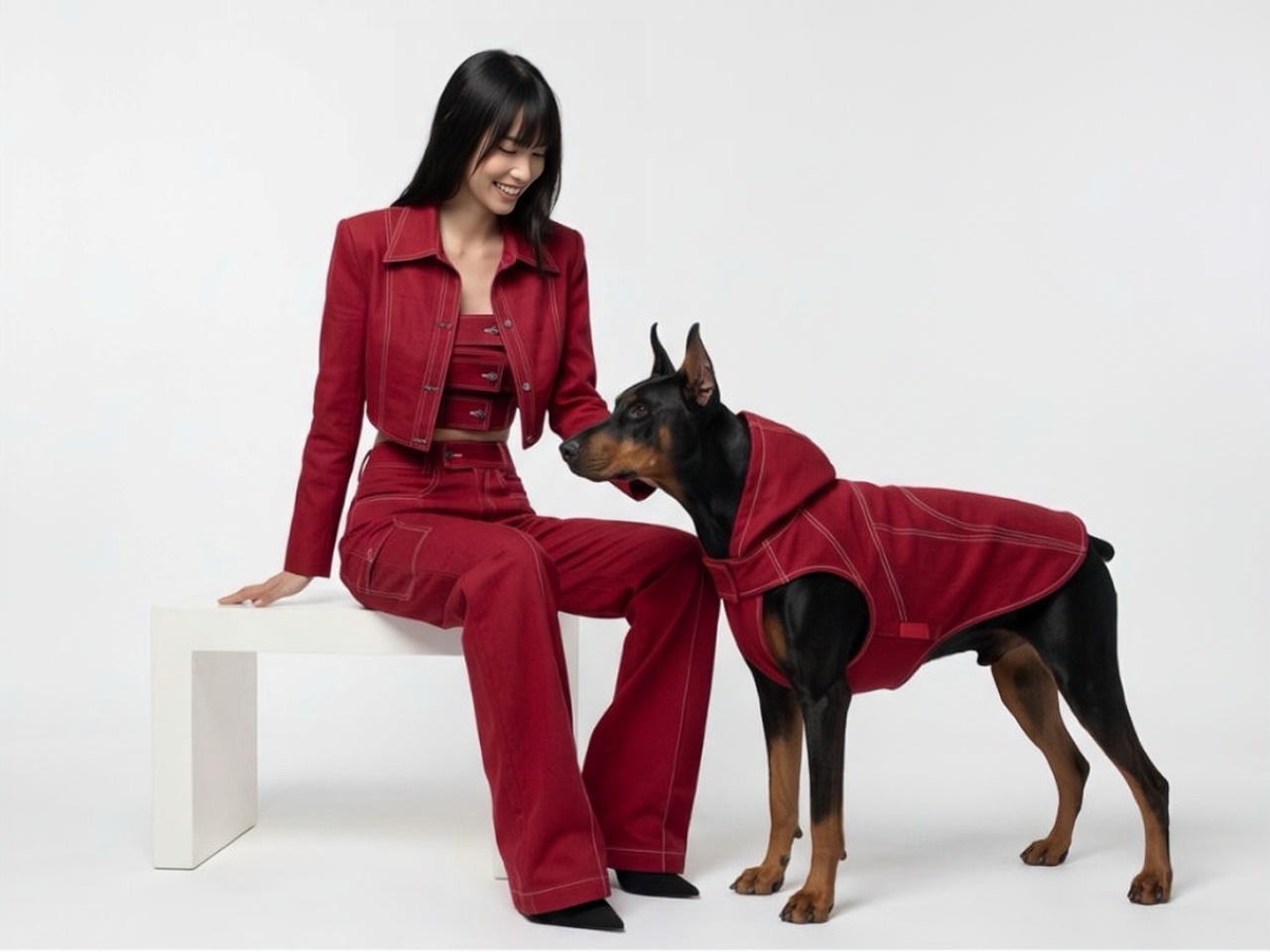
Table 3: Three tools, three jobs
| Tool | What it replaces | What it produces | Who uses it |
|---|---|---|---|
| Design | A pattern maker redrawing a human cut for a dog's body | Pet-version design drawings from an existing garment | Product and design |
| Efficiency | A dog, a handler and a studio day per breed | Interaction and catalogue images across 30+ breeds | Ops and marketing |
| Creativity | The limit of only showing the breeds you can book | Style and breed variants to test, refreshed each season | Growth and social |
The effect is a set that gets designed rather than sourced. You start from the garment you already sell, and the pet half follows — with 99% texture preservation, so the two still look cut from the same bolt of cloth. Two things stay yours: the generated garment must match the real one in colour, closure and trims, and any frame containing a photorealistic synthetic person must carry the contains-synthetic-performer tag before upload [10]. Get those right and the breeds, the cuts and the catalogue stop being constraints.
The takeaway
Matching owner and pet outfits is not a seasonal novelty that caught on. It is the point where three durable behaviours intersect: a social format that rewards coordinated imagery, a customer base that pays a 30–50% premium for personalisation, and a production model where the pet garment is the cheap half of a premium decision.
The brands that win this category will not be the ones with the cleverest copy. They will be the ones whose catalogue can show the set — the same yarn, the same palette, on the breeds their customers actually own — in the six weeks when it matters. That is a design and photography problem dressed as a fashion trend, and it is now solvable on a schedule.
Sources
- IQHashtags, #matchingset — related hashtag statistics — https://iqhashtags.com/hashtags/hashtag/matchingset
- Tailstalks, The Pet-Inspired Fashion Revolution: Trends, Innovations, and Influences (search volume, Q4 seasonality) — https://tailstalks.com/articles/luxury-pet-fashion-unleashed
- Intel Market Research, Dogs Clothes & Shoes Market (return rates, custom tailoring cost, Q4 concentration) — https://www.intelmarketresearch.com/consumer-goods/33888/dogs-clothes-shoes-market
- Pup Chic, Matching Dog & Owner Outfits: Complete Style Guide (2026) — https://pupchic.boutique/blogs/thepack/matching-dog-owner-outfits-complete-style-guide-2026
- Ridiculously Pretty / Fashionista, Now Your Dog Can Be a Sandy Liang Girl, Too (Little Beast × Sandy Liang pricing) — https://www.ridiculouslypretty.com/now-your-dog-can-be-a-sandy-liang-girl-too/
- Etsy Community, Etsy Insights: Pet Shopping Trends (search growth, July 2026) — https://community.etsy.com/forum/etsy-success-300/topic/etsy-insights-pet-shopping-trends-186666/
- Embroidery N Sewing, Clothes Embroidery Design Trends Worth Stitching in 2026 (personalisation preference and price premium) — https://embroiderynsewing.com/articles/clothes-embroidery
- Global Growth Insights, Pet Apparel Market (premium customisation preference) — https://www.globalgrowthinsights.com/zh/market-reports/pet-apparel-market-126663
- Furvibe — AI pet product photography for pet brands — https://furvibe.app
- Amazon Seller Central, Product image guide (accuracy and AI-people tagging) — https://sellercentral.amazon.com/help/hub/reference/external/G1881
- Grand View Research, Pet Clothing Market Size, Share & Trends Analysis — https://www.grandviewresearch.com/industry-analysis/pet-clothing-market-report